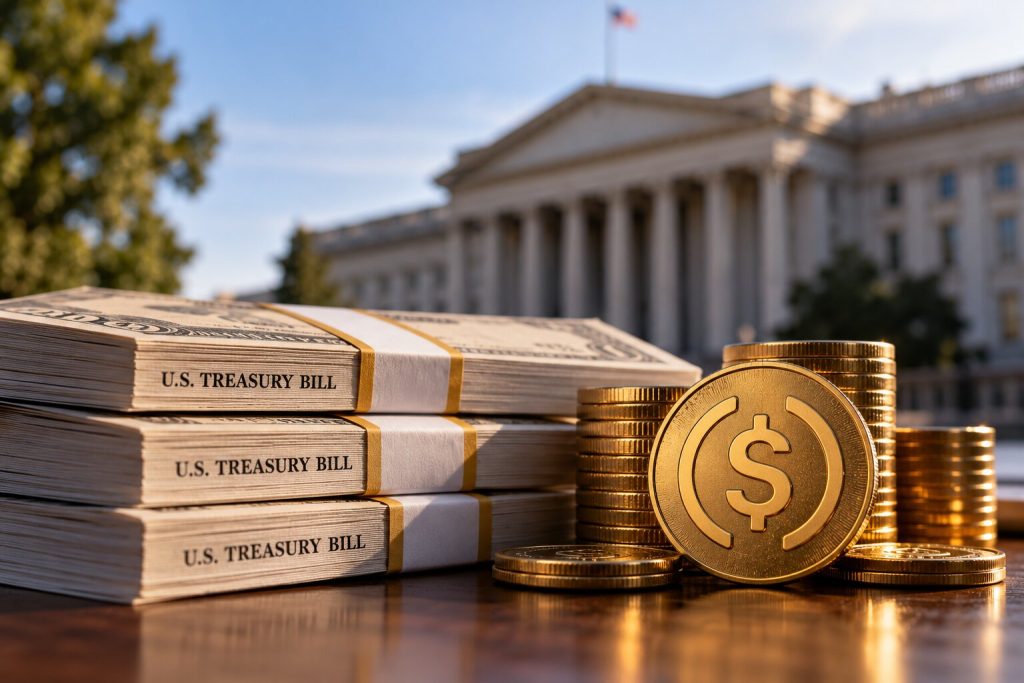

Why a dollar token holds Treasury bills
A payment stablecoin is designed to be redeemed, typically one-for-one, for a national currency. Most of the large ones are tied to the U.S. dollar. To make that promise credible, the issuer has to hold assets that can be turned into dollars quickly if holders ask to redeem.
That is the mechanical link to short-term government debt. Treasury bills, and overnight repurchase agreements backed by Treasury securities, are among the most liquid dollar assets in the world. They are also the kinds of instruments U.S. law now lists as eligible reserves for regulated payment stablecoins.
The connection is sometimes described as if stablecoin issuers had become a new class of foreign official buyer. The resemblance is only partial. A foreign central bank may hold Treasuries for reserve management over many years. A stablecoin issuer holds short-term government paper, or claims on that paper, so that tokens can be redeemed on demand. The first is a long-term reserve portfolio. The second is closer to the liquid book of a money-market fund.
What the GENIUS Act requires
On July 18, 2025, the Guiding and Establishing National Innovation for U.S. Stablecoins Act, or GENIUS Act, was signed into law as Public Law 119-27. Section 4 requires a permitted payment-stablecoin issuer to maintain identifiable reserves backing outstanding payment stablecoins on at least a one-to-one basis.
The permitted reserve list is narrow. It includes U.S. coins and currency and balances at a Federal Reserve Bank; demand deposits at insured depository institutions; Treasury bills, notes, or bonds with a remaining maturity of 93 days or less, or issued with a maturity of 93 days or less; overnight repurchase agreements backed by short-dated Treasury bills, and overnight reverse repurchase agreements collateralized by Treasury notes, bills or bonds, subject to specified conditions; shares of government money-market funds invested only in those same instruments; and certain other similarly liquid federal government assets approved by regulators.
The same section generally prohibits the issuer from pledging or reusing those reserves, with limited exceptions. Issuers must publish the monthly composition of reserves and have the prior month’s disclosure examined by a registered public accounting firm. Payment stablecoins are not backed by the full faith and credit of the United States, are not government-guaranteed, and are not covered by federal deposit insurance. The law makes it unlawful to represent otherwise. The statute also bars issuers from paying holders any form of interest or yield solely in connection with holding, using or retaining the token. A regulated payment stablecoin is designed as a means of payment whose backing sits, to a large degree, in the front end of the Treasury market.
A September 2026 Economic Letter from the Federal Reserve Bank of San Francisco summarized the same point: the Act “will require that domestic issuers approved under the Act back stablecoin issuance one-to-one with high-quality liquid assets, such as Treasury bills.”
How large is this bid today?
The San Francisco Fed letter is the most recent official analysis that ties issuer holdings directly to the Treasury market. As of mid-August 2026, it said, the two largest dollar stablecoins, Tether and USD Coin, were estimated to make up more than 80 percent of market capitalization. Both aim at one-to-one convertibility into dollars. Both hold a large fraction of their assets in short-term Treasury securities, along with cash, bank deposits, and repurchase agreements.
Over the past five years, the letter said, those two issuers increased their Treasury security holdings by about $200 billion. The authors counted Treasury bills and repurchase agreements together in that total. They compared the increase with the decline in China’s Treasury holdings over the same period and estimated that the stablecoin increase was more than 40 percent of China’s decline. The comparison comes with a maturity mismatch: China’s reduction has been mostly in longer-term debt, while stablecoin issuers have been adding short-term paper.
At the bill end of the market, the letter found that since 2023 stablecoin issuers have increased their holdings of short-term Treasury securities by more than Japan, the largest non-U.S. holder of Treasuries overall. Foreign official institutions have also added bills since 2023, a pickup the authors said was largely driven by Japan. The stablecoin bid has therefore been showing up in the same part of the market where some official accounts have also been more active.
Circle, the issuer of USDC, states on its transparency page that USDC is always redeemable one-for-one for U.S. dollars and that reserves include bank deposits, overnight reverse Treasury repurchase agreements, and Treasuries with maturities of less than three months. It says the majority of the USDC reserve is held in the Circle Reserve Fund (USDXX), an SEC-registered government money-market fund that can hold cash, short-dated Treasuries, and overnight Treasury repurchase agreements. The page, viewed in early November 2026, lists those categories as of November 2, 2026, and notes weekly public disclosure plus monthly third-party assurance. The dollar amounts on that dashboard are updated frequently and should be copied from the issuer’s site at the time of publication rather than frozen here.
An April 8, 2026, FEDS Note by Board staff put aggregate stablecoin market capitalization at $317 billion as of April 6, 2026, more than 50 percent higher than in early 2025. That older figure is a dated marker of scale, not a current total.
What this demand is not
Even after several years of growth, the San Francisco Fed described stablecoin holdings as “relatively small” next to the U.S. government’s financing needs. The letter included a simple extrapolation: if the recent trend continued, demand for short-term Treasury securities from this source could nearly double to about $400 billion by the end of 2030. The authors labeled that exercise a projection that “embeds a lot of uncertainty,” depending on regulation, competing products, and whether new holders are people who did not already own Treasuries. It is not a forecast, and it is not a statement about future yields.
The letter also cited research, including a 2026 BIS report, finding that issuer demand has already been large enough to have a measurable effect on short-term yields. A measurable effect is not a claim that stablecoins now set bill rates.
Stablecoin reserves also are not a substitute for deposit insurance or for a central-bank liability. The GENIUS Act is explicit on that point. Board staff, writing in April 2026, argued that even tokens with safer and more liquid reserves still create interconnections with the traditional financial system, including run risk if holders doubt they can redeem at par.
For readers of the Treasury market, the factual core is narrower. A new, regulated class of private dollar tokens is required to hold short-dated government paper, or claims on that paper, against every token outstanding. Two large issuers already do so on a scale that official researchers measure in the low hundreds of billions of dollars and compare with the changing official bid from China and Japan. That is a real, sourced change in the front end of the government debt market. It is not evidence that the Treasury market has a new residual buyer of last resort, and it is not a recommendation to hold, avoid, or use any token.
Data as of: San Francisco Fed Economic Letter using a mid-August 2026 snapshot of the two largest issuers; GENIUS Act enacted July 18, 2025; Circle transparency page dated November 2, 2026 (categories only); Board staff FEDS Note figures as of April 6, 2026.